You'd think the person with the answer to this question would be heralded as modern societies saviour, the person who solved the mystery of why we gain weight and can't seem to lose it. Or perhaps at least this person would be rich in finding a way to capitalize on such a discovery.
There are indeed many who have become wealthy in selling their solution to the weight loss problem but in doing so another mystery arises; if all these people with the solution to weight loss do have the answer, why is it the population of the entire planet continues to become more overweight every year?
When humanity learned how to eradicate smallpox it was the end of smallpox. We have the antidote for excessive weight gain, but don't use it.
More of the population is overweight. This seems a logical explanation for why more weight loss clinics classes, blogs, news stories, and apparently novel weight loss concepts would materialize.
It's a question of supply and demand.
Interesting that the more this problem spreads the more full-proof solutions are propagated and sold.
Maybe at some point sock makers would sell so many socks that all the worlds people would have socks so no more socks would be needed. Too simplified. The population grows, socks wear out, and maybe people want to upgrade from $5.00 socks to $10.00 socks and so on.
Is fat loss the same way? Does one weight loss strategy wear-out requiring another strategy to continue weight loss? Is the more costly fat loss option more effective?
This can't be true because fat loss is about eating fewer calories than expended. There isn't another strategy. It is that simple, but complexities arrise in achieving that simplicity.
The National Weight Loss Registry, an ongoing study of what people who successfully lose weight and keep it off actually do has found the following:
To register people must have lost at least 30 pounds and kept it off for one or more years.
Registry members have lost an average of 66 pounds and kept it off for more than 5 years.
The study is open to US residents and has published it's findings to date.
Here is what those who have lost weight and kept it off have in common:
45% lost weight on their own and 55% lost weight with the help of some kind of program
94% increased their physical activity with walking being the most common exercise, and one hour of exercise daily being average frequency and duration.
98% of Registry participants report that they modified their food intake in some way to lose weight.
78% eat breakfast every day
75% weigh themselves at least once per week
62% watch less than 10 hours of TV per week
The increase in physical activity increases calories out and the modification of food intake decreases calories in.
I'm writing this during the Christmas holiday season, but what I'm saying is relevant anytime of the year.
A common strategy that people tell me about when they are about to enter a social feeding frenzy, be it a birthday, an after the game or after the whatever chow-down, is this:
Since we're going to overeat anyway, why bother trying to mess with that since it won't work. Why not simply concentrate our efforts on what to do after we're finished the overeating celebration?
Makes sense. Christmas dinners? I've already bought the ticket to that train and I'm going to ride it out. Plus; why ruin Christmas (or whatever)?
"I just want to have a good type two diabetes with my family". Crap. Freudian.
What I meant to say sarcastically is, "I just want to have a good time feeling bloated and regretful for overdoing it and gaining even more weight". Whoops, I did it again.
The flaw in this strategy is that it is completely denial based and is merely used as an excuse to justify more overeating. Hardly anyone is actually going to follow through with the "I'll deal with it later" self afflicted con-job.
What is the expected outcome of never preventing overeating and always thinking about what to do after overeating?
Most will tell you the expected outcome is successful weight loss.
Crazy-talk.
We are crazy about overeating, even when we know better.
Like I've said before in previous ramblings, the current consensus is that decisions surrounding eating are largely bound to seeking gratification. Not just any gratification, but the kind that has greatest power to amputate our better judgment.
Instant gratification.
This is ultimately what the 5% of the population are tapping into when they successfully lose weight and keep it off; understand the source of instant gratification and doing something about it.
They modify their behaviors and feelings about food and eating to such an extent that they no longer fall prey to their self-generated compulsion to overeat. Indeed the compulsion itself is greatly diminished down to a realistically manageable state.
Everyone who loses fat does it the same way. They consume fewer calories than expended.
The 5% who keep it off do so not by short term dietary and exercise habit changes, but rather over very long periods of lifestyle management.
The success is in realizing that overeating is just not worth the trouble.
We can all follow the habits of the the study subjects in the National Weight Control Registry.
If we did we would all permanently lose weight and keep it off. It's the "permanently" part that get most people (95%), as within mere weeks of implementing these proven habits, most people will feel like they are missing their doses of instant gratification. Most will feel compelled to fall back into the habits and social practices that promote and celebrate overeating.
When you surly love overeating there is nothing in the world that will break that love.
Wait.. There is one thing. It's the relationship killer.
Cheating.
No, I'm not talking about "cheat days" where you overindulge to cool your heals during a diet phase.
I'm talking about your love partner cheating on you. I'm talking about overeating stabbing you in the arteries while making love to your tastebuds and that part of the brain that allows you interpret the sensation of "wow, this is really good".
I'm talking about the epiphany the 5% get when they realize that the way they are living is not really making things better, but worse.
The hardest part about changing to healthy living habits is letting go the reward association with overeating and inactivity and making new reward associations with healthy eating and exercise.
If you don't fall for healthy living like falling in love you will forever be chained to the old relationship. The abusive relationship where you beg for those few moments of feeling good only to be burdened with lethargy, weight gain, and health issues surrounding unhealthy living.
Call me preachy if you like. I'm just telling it like it is and have no intentions of being a lifestyle judge and jury or diet zealot / guru.
I only write what I feel and what I have learned through reading research. My delivery is what it is.
Implement what I say though and you won't be doing what I say, but rather doing what research suggests we can do to escape one of the greatest societal plagues ever: the love and celebration of chronic overeating.
Cris LaBossiere

Strength training and mountain biking. My two favorites
Showing posts with label overweight. Show all posts
Showing posts with label overweight. Show all posts
Sunday, December 23, 2012


Wednesday, October 24, 2012
Junk food - healthy food cost/ tax comparison
A quick follow up on my piece on the Ontario Medical Association trumpeting their bold and supposedly new recommendations on curbing obesity by reducing tax on healthy food and increasing tax on unhealthy food.
I went to a grocery store, bought some junk food and some healthy food, and compared the receipts..

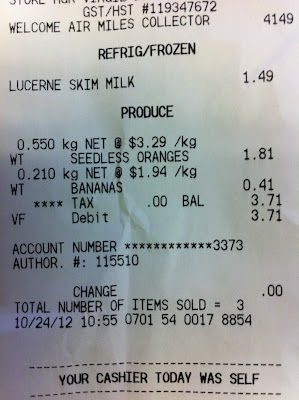


WTF? Something must be wrong with the receipt printer.. The damn thing shows NO TAX on the healthy food. This can't be. The Ontario Medical Association is having a hay-day in the media talking about their egalitarian concept to save Canada's overweight population by reducing tax on healthy food.
I didn't pay any tax on this healthy food. How does a tax get less than zero? I did pay tax on the junk food though, and the junk food was a buck more when compared to a similar number of servings of healthy food. yes you read that right.. the junk food cost more than the healthy food.
Do the doctors at OMA ever go shopping for food?
Did they actually check what foods are currently taxed and which are not before winding up their boisterous media blitz?
No? Whoops, minor oversight there.
As usual I do the heavy lifting and uncover the uncomfortable truth that nobody else does.
Actually I did a simple Google search; food tax Canada, and, looked at my grocery receipt.
This is not difficult to figure out, but, as usual, political hyperbole and media sensationalism distract people from the reality right in front of our faces. More entertaining to pay attention to the dancing bear than look at actual facts.
This link will show you all the foods that are and are not taxed in Ontario. All the provinces have near identical lists for provincial taxes, as does the country as a whole for GST and HST.
http://www.cra-arc.gc.ca/E/pub/gm/4-3/4-3-e.html
I really want Canadians to eat less and change their social norms so that healthy eating is embraced instead of scoffed at. I wouldn't mind seeing some of our tax dollars being put to good use with useful initiatives to help reduce and prevent the ever growing number of Canadians that are overeating their way to obesity and the ensuing health problems that hurt them.
I'm not going to hold my breath..
Back to reality..
Some research suggests that 10% tax on junk food can reduce purchases of junk food.
Of course, I have a serious problem with this research as most healthy food has long been cheaper, or at least competitively priced with junk food, yet most of our population choose junk food over healthy food much of the time.
Take a look at the receipts I've posted here. The 1 L of pop was $1.34 and the 1 L of skim milk 1.49. That's an insignificant difference. The pop was on sale so I payed $1.00 for it plus 12 cents tax. Still an insignificant difference.
What would the price look like with another 15% tax (30% total tax).. a doubling of the current tax?
Instead of paying $4.75 for a bag of chips and a pop I would have had to pay $5.49, 74 cents more.
I don't eat junk food (I gave away my junk food to an all too eager taker) so I don't care how much it costs. But for those who love their chips and pop I think most will find a way to pay an extra 10% or 15% over what they're paying now.
People overeat because they enjoy it, not because healthy choices are more expensive. "I'm going back for seconds on triple cheese pizza because broccoli is expensive." Nope, doesn't happen. You go back for seconds because it tastes so damn good you want more. That's the way that works. Good research shows that overeating fatty, sugary, salty food alters appetite regulation causing increased hunger and decreased satiety. The more you eat, the more your appetite regulation adapts to eating more.
And because of how our brain organizes memories of rewarding experiences, when we're hungry again we're likely to remember that we like pizza, so that is what we seek. These foods stimulate an above normal excitation of reward centres in the brain. That's why we perceive them as tasting extra good compared to a great tasting apple. Apple tastes great, but doesn't put reward perception into overdrive.
This is one of the strongest drivers of seeking out these foods. People are not strongly compelled to buy junk food because it's cheaper. People seek it out because of altered appetite and reward seeking regulation, a side effect of consuming these foods. Not to mention the fact that socially, junk food is more respected than healthy food.
This isn't about changes taxes, it's about changing behavior, and moving away from perceiving junk food as better than healthy food.
The whole add new tax to junk food thing is BS, top to bottom anyway, since it's already taxed.
So as far as the grocery store is concerned, which is where most Canadians will be spending most of their food budget, healthy food already has no tax and is cheaper than junk food which is taxed.
What about restaurants and delicatessens? Selfishly I would like to pay no tax on deli salads, where I and everyone else currently pays GST and PST on every menu item.
Because there is tax on healthy restaurant foods there exists the potential to mess with taxes here, but I'm still not completely sold on the idea that a fat tax or healthy = no-tax is going to be a reasonable primary strategy in the reversal of obesity in Canada.
The Ontario Medical Association seems to be aloof in placing at the top of their list of anti fat commandments a fat tax and reduced tax on healthy food for the obvious reasons I've already stated.
You know, why don't we just ignore the commandments from on high and start eating less. We'll feel much better dropping a few pounds.
I went to a grocery store, bought some junk food and some healthy food, and compared the receipts..


WTF? Something must be wrong with the receipt printer.. The damn thing shows NO TAX on the healthy food. This can't be. The Ontario Medical Association is having a hay-day in the media talking about their egalitarian concept to save Canada's overweight population by reducing tax on healthy food.
I didn't pay any tax on this healthy food. How does a tax get less than zero? I did pay tax on the junk food though, and the junk food was a buck more when compared to a similar number of servings of healthy food. yes you read that right.. the junk food cost more than the healthy food.
Do the doctors at OMA ever go shopping for food?
Did they actually check what foods are currently taxed and which are not before winding up their boisterous media blitz?
No? Whoops, minor oversight there.
As usual I do the heavy lifting and uncover the uncomfortable truth that nobody else does.
Actually I did a simple Google search; food tax Canada, and, looked at my grocery receipt.
This is not difficult to figure out, but, as usual, political hyperbole and media sensationalism distract people from the reality right in front of our faces. More entertaining to pay attention to the dancing bear than look at actual facts.
This link will show you all the foods that are and are not taxed in Ontario. All the provinces have near identical lists for provincial taxes, as does the country as a whole for GST and HST.
http://www.cra-arc.gc.ca/E/pub/gm/4-3/4-3-e.html
I really want Canadians to eat less and change their social norms so that healthy eating is embraced instead of scoffed at. I wouldn't mind seeing some of our tax dollars being put to good use with useful initiatives to help reduce and prevent the ever growing number of Canadians that are overeating their way to obesity and the ensuing health problems that hurt them.
I'm not going to hold my breath..
Back to reality..
Some research suggests that 10% tax on junk food can reduce purchases of junk food.
Of course, I have a serious problem with this research as most healthy food has long been cheaper, or at least competitively priced with junk food, yet most of our population choose junk food over healthy food much of the time.
Take a look at the receipts I've posted here. The 1 L of pop was $1.34 and the 1 L of skim milk 1.49. That's an insignificant difference. The pop was on sale so I payed $1.00 for it plus 12 cents tax. Still an insignificant difference.
What would the price look like with another 15% tax (30% total tax).. a doubling of the current tax?
Instead of paying $4.75 for a bag of chips and a pop I would have had to pay $5.49, 74 cents more.
I don't eat junk food (I gave away my junk food to an all too eager taker) so I don't care how much it costs. But for those who love their chips and pop I think most will find a way to pay an extra 10% or 15% over what they're paying now.
People overeat because they enjoy it, not because healthy choices are more expensive. "I'm going back for seconds on triple cheese pizza because broccoli is expensive." Nope, doesn't happen. You go back for seconds because it tastes so damn good you want more. That's the way that works. Good research shows that overeating fatty, sugary, salty food alters appetite regulation causing increased hunger and decreased satiety. The more you eat, the more your appetite regulation adapts to eating more.
And because of how our brain organizes memories of rewarding experiences, when we're hungry again we're likely to remember that we like pizza, so that is what we seek. These foods stimulate an above normal excitation of reward centres in the brain. That's why we perceive them as tasting extra good compared to a great tasting apple. Apple tastes great, but doesn't put reward perception into overdrive.
This is one of the strongest drivers of seeking out these foods. People are not strongly compelled to buy junk food because it's cheaper. People seek it out because of altered appetite and reward seeking regulation, a side effect of consuming these foods. Not to mention the fact that socially, junk food is more respected than healthy food.
This isn't about changes taxes, it's about changing behavior, and moving away from perceiving junk food as better than healthy food.
The whole add new tax to junk food thing is BS, top to bottom anyway, since it's already taxed.
So as far as the grocery store is concerned, which is where most Canadians will be spending most of their food budget, healthy food already has no tax and is cheaper than junk food which is taxed.
What about restaurants and delicatessens? Selfishly I would like to pay no tax on deli salads, where I and everyone else currently pays GST and PST on every menu item.
Because there is tax on healthy restaurant foods there exists the potential to mess with taxes here, but I'm still not completely sold on the idea that a fat tax or healthy = no-tax is going to be a reasonable primary strategy in the reversal of obesity in Canada.
The Ontario Medical Association seems to be aloof in placing at the top of their list of anti fat commandments a fat tax and reduced tax on healthy food for the obvious reasons I've already stated.
You know, why don't we just ignore the commandments from on high and start eating less. We'll feel much better dropping a few pounds.
Saturday, October 6, 2012
Why we fall for diet and exercise myths
Slow metabolism makes weight loss difficult, preventing many from losing weight
It's hard to get vitamins and minerals from food, we need pills
To get fit, we need exercise that beats the hell out of us
Carbs make you fat
Let me demolish these four myths
The power and durability of the common urban myth is often greater than what the truth is. While disassembling urban myths gives me personal short term gratification because it makes me feel like I'm making a difference in the world by conquering the dark side, the satisfaction I feel is undeserved because in reality I'm not making much of dent.. I'm up against something bigger than me. Who, or what, is keeping these myths alive?
Is it big brother? Big fast food? A cult movement? Darth Vader?
Nope. It's a 3 pound gelatinous mass that has infested 100% of humans, and we can't get rid of it.
The human brain.
Dum dum duuummm! - that's dramatic music, not a slag against dumb brains. Although that works too.
I have been told that my brain is up my um.. well you know where. I'm not sure if this is a genetic trait or perhaps I have an advanced mutation that occurs in higher (or lower) thinking evolving humans. Wherever the location, the brain is bit of a busybody recluse doing a heck of a lot of work behind the scenes, often to our detriment.
Don't believe me? Ever tried finding your keys? You would think your brain could remember this one simple value. Even when you nail a key hook to the wall, there is no guarantee that your brain will remember that this is where keys go, and confoundingly, when keys are placed there, your brain won't remember putting them there.


Myths play to our denials
Denial ; something we do when it's too hard to face reality. The brain is really, really good at denial. In fact studies have shown that when we're presented with plane, easy to understand facts that refute our current beliefs our brains go into "FU" (False Understanding) mode and our belief in that which is clearly wrong is strengthened.
We humans can be somewhat stubborn when trying to get a grip on reality, and we have a lot of historical boondoggles to show for it.
It seems our natural instinct is to deny facts. More facts? Bring on more myths to support our denial.
"Cris, you should quit smoking". Did I like hearing that? My defence?
Get angry with the person (redirect away from subject of me smoking).
Make up some crap about them meddling with my life (redirect).
Claim that is hasn't hurt me so far (denial), that lot's of old people smoke and they're not dead yet (redirect/ denial of how it affects me personally).
Demonize the person delivering the message (so I could make it feel easier to discredit their quit smoking concerns).
Having been in denial of reality and a believer of some these myths myself I can say I know exactly where the myth believers are at.
If my writing style had the talent of brevity I might write something like, "You're all wrong. Cut the crap and get real. You'll be better off.".. I could make this would a one line blog entry.
I'm not so talented though so I make satirical references hoping that that my cro-mag humour will lull you into reading more of my stuff.
On with the myth busting..
Slow metabolism makes losing weight more difficult.
It's difficult to change our habits and eat less and exercise more to lose weight, but a slow metabolism isn't one of the things working against us; slow metabolism causing weight gain is a myth.
What's more work; walking up stairs carrying just yourself, or walking up stairs carrying 40 pounds of bricks?
Of course it could be 40 pounds of anything, but hey, bricks sound heavier.
The more we weigh the more energy we expend to move our bodies around. Comparing our lean selves to our extra weight selves, the extra weight version will always expend more energy doing the same tasks. Even sitting down relaxing is more energy intensive when we weigh more.
Our breathing muscles have to work harder to move the extra mass on our upper bodies to allow our ribs to expand to fill the lungs. When resting metabolism is measured the heavier versions of ourselves will always burn more calories at rest than the leaner version.
Resting metabolism increases as body fat increases, the exact opposite of the myth that suggests weight gain slows metabolism.
"Whoa, whoa there Cris. OK fine, calories in calories out.. whatever. You can't seriously be in denial of true health disorders that actually do reduce metabolism can you?
Ever heard of hypothyroidism? Look who's in denial now!
Gotcha Cris!"
I put that in here because I've actually had people say those words to me.
Here's an excerpt from the American Thyroid Associations brochure on Thyroid and Weight
Hypothyroidism does not cause excess fat gain. Most of the weight gain that occurs with hypothyroidism is water mass. If a persons primary complaint is excess weight gain, Hypothyroidism will not be a suspect for the weight gain, even if Hypothyroidism is diagnosed. Eating too much and not enough physical activity will be suspect.
Here are the facts for all to deny..
[Obesity and hypothyroidism: myth or reality?]. [Rev Med Suisse. 2007] - PubMed - NCBI
Weight loss after therapy of hypothy... [J Clin Endocrinol Metab. 2011] - PubMed - NCBI
The only way to gain excess body fat is to eat too much, hypothyroidism alone cannot cause extra fat to accumulate in the human body.. that is in fact, an urban myth, a myth to support the denial of overeating. This myth drives peoples creativity to generate other myths, such as believing there are special foods or food combinations that will speed up metabolism, or special exercise routines that increase metabolism after exercise. Admitting to ourselves and others that we eat too much can feel bad, so we deny we eat too much.
If our daily energy expenditure reduces, we need to eat less to match the reduced energy expenditure. Hypothyroidism can make people feel tired and less likely to be active. Less activity means fewer calories expended. If a person develops hypothyroidism and becomes less active, but doesn't eat less to compensate, fat gain will occur from eating more calories than expended.
Only about 4 to 5% of the population has hypothyroidism so thyroid problems can't be the main driver for 60 to 70% of the population being overweight. But due to the pervasiveness of the thyroid and metabolism myth, many people will self-diagnose themselves as having some kind of metabolism challenge as the root cause of their weight gain. When facts are presented showing that this is really not the case, many can feel like they're being attacked and dismissed . What's really happening is their brains are refusing the new information, they're in denial, and they want to stay in denial by perceiving others as picking on them.
I'm not talking about the unacceptable nonsense of teasing someone because they are overweight or skinny for that matter. I'm talking about straight talk about why we eat too much. I wish the social stigma of overeating wasn't so strong, that would make it feel more comfortable talking about a problem that affects so many of us.
Here's a study that revealed why diet resistant people were not losing weight.
Discrepancy between self-reported and actual ca... [N Engl J Med. 1992] - PubMed - NCBI
The study examined obese people who "perceived a genetic cause for their obesity, used thyroid medication at a high frequency, and described their eating behaviour as relatively normal." However the researchers revealed these study subjects underreported their food intake by 47% and over-reported physical activity by 51%.
Study conclusions: The failure of some obese subjects to lose weight while eating a diet they report as low in calories is due to an energy intake substantially higher than reported and an overestimation of physical activity, not to an abnormality in thermogenesis.
They ate too much and didn't exercise enough and were in denial of this reality, to support this denial they bought into the myth of a genetic problem causing slow metabolism, causing weight gain. It's a difficult place to be. Difficult to talk about openly. That's one of the principal assets of denial; it's a protective mechanism that allows us not to face an uncomfortable truth.
That's how myths survive. Myths play to our denials and play up our unrealistic hopes. Diet and exercise myths tell us that eating too much didn't cause our weight gain. Myths tell us to engage in crazy short term exercise plans because long term plans feel too daunting and we don't want to face that reality. Long term exercise plans are actually not daunting but in reality are continually rewarding and liberating as we continue to increase fitness long term.
Hard to get vitamins and minerals from food
Here's a nutrient profile from a day of my own eating.


This myth comes from many places, one of the more common is from athletics. No doubt; we can't develop peak athletic ability without pushing hard, really hard. This leads many to jump the gun and superimpose elite athlete training onto those with little or no developmental training.
To gain performance we need to push hard, but only when we're trained enough to handle it otherwise injury and overtraining occur.
Not everyone is into trying to develop performance. Why then are the majority of fitness programs based on killer gut busting workouts? Because that's what sells. It's a good business model.
Many believe in the myth that you have to exercise really hard and feel really sore to get a worthy workout. Why not sell people what they believe they want? This keeps the myth going.
The truth is productive exercise is moderate to easy most of the time, only reserving the more challenging workouts for when we're durable enough to do hard work, or when we're recovered enough from our last hard effort.
Healthy productive exercise takes time and a gradual progression. Since we want results yesterday, we create myths telling of fast results from "advanced" workouts. These myths support our denial of the fact that it takes months and years to get fit, not days or weeks.
Here are a few blog entries on the subject
Young athletes forced to train too much
Runners get injured, then incur another injury before healed
Too much too soon injures pro's and 1st timers alike
Carbs make you fat
Do people ever love this myth. It serves many purposes. Allows us to believe that we didn't overeat to gain weight, it's those damn carbs. It allows us to make double bacon and egg sandwiches and laugh at those "nuts" eating veggies. News flash.. only eating too much causes weight gain. It doesn't matter if its carbs, fat, or protein.
Cut the high fructose corn syrup, pop, and high sugar snacks? You bet, but don't toss the whole grains, fruits, veggies, beans, legumes, and potatoes.
If you cut out most of your carbs, What does that mean? No really, what is that? Well if your daily carb rich muffin has 300 calories in it, and your daily white bread daily has another 300 calories, and that serving of rice, pasta, or potato each have 200 calories, and you're cutting all that out you're.. wait for it..
Cutting hundreds of calories per day!
Let's take a look at a typical low carb diet day..


These meals were taken off a "low carb" recipe web site. Although this day of food intake is a few hundred calories more than my own intake detailed above, it doesn't deliver all the vitamins and minerals that mine did, it comes up short on meeting daily needs. That's what happens when you cut out or dramatically reduce carbohydrate sources; you drop a primary source of vital nutrients. As expected though, the nutrients found in meats and fish are in abundance. Don't be going into denial and say, "look at those five nutrients! They're off the chart! Low carb must be good." This warped perspective is expected though, based on what we know about our ability to deny objective facts so we can sustain our current beliefs.
Sure, 5 nutrients are delivered in spades, but 8 come up short. We will choose to deny the significance of over half of our nutrients needs not being met by focusing on information that supports our denial.
What I found most interesting is that the website I took these recipes from claimed that each day of meals delivered fewer than 20 grams of carbs per day, as 20 grams of carbs per day is supposedly the magic number for carb intake. When analyzed though, the actual amount of carbs is double what is claimed. Should I be surprised that a website supporting a myth based diet has incorrect data on it?
Typically low carb diets emphasize fats and proteins. Interestingly a person would have a better chance of losing weight eating my diet compared to the low carb diet as mine had fewer calories.
My carb sources were whole grains, fruits, and veggies. No refined sugars except what occurs in the multigrain bread, but this is insignificant.
Low carb extremists have become slightly more savvy since the typical low carb diet has been publicly eviscerated and its nutrient deprived profile revealed for all to see. The modern low carb diet has more veggies and more carbs in it than the traditional (but still popular) variant I've used here.
So what does that mean? Does that mean after decades of the validity of the low carb diet being hammered by the facts, the low carb'ers finally started to see past the myth and thus alter the low carb diet by what.. Increasing carbs via more veggies, grains, and fruits? Say it ain't so. Give it a couple more decades of maturing and the low carb diet will evolve into a normal diet.
The basic slight of hand (or mouth) scam of the low carb diet is diverting your attention from calories in/ out and focussing on carbohydrates. In reality you're cutting calories.
If you cut out hundreds of calories daily you're going to lose weight so long as you eat fewer calories than you expend.
The low carb restrictive diet isn't sustainable. The science shows that most people eventually gravitate back to eating the way they did before and gain back all the weight they lost plus more.
So if the low carb thing is a myth, why do so many fall for it? Why do people keep smoking? Why do people buy snake oil? Why do smart people make dumb decisions?
It's the brain! Blame it on the brain. Once we humans believe something, it's near impossible, despite good evidence, to change that belief. Our brains also get used to reward seeking patterns and if our brain knows we're going to feel rewarded from high doses of fat, salt, and sugar, then that is what we will crave.
If we've developed a habit, it can be very hard to quit because our brains are wired to keep it up, even if it's bad for us. So is this denial as well? It's not me, it's my brain? Sure, this could definitely be used as an excuse to not change.. but it is our brain, and ultimately we can make efforts that do make for long term positive outcomes
Eating less and exercising are not actually all that difficult. What is difficult is overcoming our prejudice, being myopic, old habits, wired in reward seeking, and our denial of reality.
I've repeated bad habits enough that they became wired in my brain; smoking, overeating, and exercising too much. I also practiced not doing these things, and making better choices. And like the stats suggest, I failed many times before I succeeded, but I did succeed and so have many others. It can be done.
That's the great thing about the brain, neuroplasticity is an adaptive asset of the brain. It can change. In fact the brain is just as good at changing as it is at maintaining the status quo. All it needs is consistency with the new thoughts and practices and it will change, we will change. Living healthy can and does feel like a relief from living by these crazy urban myths.
It's hard to get vitamins and minerals from food, we need pills
To get fit, we need exercise that beats the hell out of us
Carbs make you fat
Let me demolish these four myths
The power and durability of the common urban myth is often greater than what the truth is. While disassembling urban myths gives me personal short term gratification because it makes me feel like I'm making a difference in the world by conquering the dark side, the satisfaction I feel is undeserved because in reality I'm not making much of dent.. I'm up against something bigger than me. Who, or what, is keeping these myths alive?
Is it big brother? Big fast food? A cult movement? Darth Vader?
Nope. It's a 3 pound gelatinous mass that has infested 100% of humans, and we can't get rid of it.
The human brain.
Dum dum duuummm! - that's dramatic music, not a slag against dumb brains. Although that works too.
I have been told that my brain is up my um.. well you know where. I'm not sure if this is a genetic trait or perhaps I have an advanced mutation that occurs in higher (or lower) thinking evolving humans. Wherever the location, the brain is bit of a busybody recluse doing a heck of a lot of work behind the scenes, often to our detriment.
Don't believe me? Ever tried finding your keys? You would think your brain could remember this one simple value. Even when you nail a key hook to the wall, there is no guarantee that your brain will remember that this is where keys go, and confoundingly, when keys are placed there, your brain won't remember putting them there.

Brain

Brain in denial.
Myths play to our denials
Denial ; something we do when it's too hard to face reality. The brain is really, really good at denial. In fact studies have shown that when we're presented with plane, easy to understand facts that refute our current beliefs our brains go into "FU" (False Understanding) mode and our belief in that which is clearly wrong is strengthened.
We humans can be somewhat stubborn when trying to get a grip on reality, and we have a lot of historical boondoggles to show for it.
It seems our natural instinct is to deny facts. More facts? Bring on more myths to support our denial.
"Cris, you should quit smoking". Did I like hearing that? My defence?
Get angry with the person (redirect away from subject of me smoking).
Make up some crap about them meddling with my life (redirect).
Claim that is hasn't hurt me so far (denial), that lot's of old people smoke and they're not dead yet (redirect/ denial of how it affects me personally).
Demonize the person delivering the message (so I could make it feel easier to discredit their quit smoking concerns).
Having been in denial of reality and a believer of some these myths myself I can say I know exactly where the myth believers are at.
If my writing style had the talent of brevity I might write something like, "You're all wrong. Cut the crap and get real. You'll be better off.".. I could make this would a one line blog entry.
I'm not so talented though so I make satirical references hoping that that my cro-mag humour will lull you into reading more of my stuff.
On with the myth busting..
Slow metabolism makes losing weight more difficult.
It's difficult to change our habits and eat less and exercise more to lose weight, but a slow metabolism isn't one of the things working against us; slow metabolism causing weight gain is a myth.
What's more work; walking up stairs carrying just yourself, or walking up stairs carrying 40 pounds of bricks?
Of course it could be 40 pounds of anything, but hey, bricks sound heavier.
The more we weigh the more energy we expend to move our bodies around. Comparing our lean selves to our extra weight selves, the extra weight version will always expend more energy doing the same tasks. Even sitting down relaxing is more energy intensive when we weigh more.
Our breathing muscles have to work harder to move the extra mass on our upper bodies to allow our ribs to expand to fill the lungs. When resting metabolism is measured the heavier versions of ourselves will always burn more calories at rest than the leaner version.
Resting metabolism increases as body fat increases, the exact opposite of the myth that suggests weight gain slows metabolism.
"Whoa, whoa there Cris. OK fine, calories in calories out.. whatever. You can't seriously be in denial of true health disorders that actually do reduce metabolism can you?
Ever heard of hypothyroidism? Look who's in denial now!
Gotcha Cris!"
I put that in here because I've actually had people say those words to me.
Here's an excerpt from the American Thyroid Associations brochure on Thyroid and Weight
"In general, 5-10 pounds of body weight may be attributable to the thyroid,
depending on the severity of the hypothyroidism. Finally, if weight gain
is the only symptom of hypothyroidism that is
present, it is less likely that the weight gain is
solely due to the thyroid."
Hypothyroidism does not cause excess fat gain. Most of the weight gain that occurs with hypothyroidism is water mass. If a persons primary complaint is excess weight gain, Hypothyroidism will not be a suspect for the weight gain, even if Hypothyroidism is diagnosed. Eating too much and not enough physical activity will be suspect.
Here are the facts for all to deny..
[Obesity and hypothyroidism: myth or reality?]. [Rev Med Suisse. 2007] - PubMed - NCBI
Weight loss after therapy of hypothy... [J Clin Endocrinol Metab. 2011] - PubMed - NCBI
The only way to gain excess body fat is to eat too much, hypothyroidism alone cannot cause extra fat to accumulate in the human body.. that is in fact, an urban myth, a myth to support the denial of overeating. This myth drives peoples creativity to generate other myths, such as believing there are special foods or food combinations that will speed up metabolism, or special exercise routines that increase metabolism after exercise. Admitting to ourselves and others that we eat too much can feel bad, so we deny we eat too much.
If our daily energy expenditure reduces, we need to eat less to match the reduced energy expenditure. Hypothyroidism can make people feel tired and less likely to be active. Less activity means fewer calories expended. If a person develops hypothyroidism and becomes less active, but doesn't eat less to compensate, fat gain will occur from eating more calories than expended.
Only about 4 to 5% of the population has hypothyroidism so thyroid problems can't be the main driver for 60 to 70% of the population being overweight. But due to the pervasiveness of the thyroid and metabolism myth, many people will self-diagnose themselves as having some kind of metabolism challenge as the root cause of their weight gain. When facts are presented showing that this is really not the case, many can feel like they're being attacked and dismissed . What's really happening is their brains are refusing the new information, they're in denial, and they want to stay in denial by perceiving others as picking on them.
I'm not talking about the unacceptable nonsense of teasing someone because they are overweight or skinny for that matter. I'm talking about straight talk about why we eat too much. I wish the social stigma of overeating wasn't so strong, that would make it feel more comfortable talking about a problem that affects so many of us.
Here's a study that revealed why diet resistant people were not losing weight.
Discrepancy between self-reported and actual ca... [N Engl J Med. 1992] - PubMed - NCBI
The study examined obese people who "perceived a genetic cause for their obesity, used thyroid medication at a high frequency, and described their eating behaviour as relatively normal." However the researchers revealed these study subjects underreported their food intake by 47% and over-reported physical activity by 51%.
Study conclusions: The failure of some obese subjects to lose weight while eating a diet they report as low in calories is due to an energy intake substantially higher than reported and an overestimation of physical activity, not to an abnormality in thermogenesis.
They ate too much and didn't exercise enough and were in denial of this reality, to support this denial they bought into the myth of a genetic problem causing slow metabolism, causing weight gain. It's a difficult place to be. Difficult to talk about openly. That's one of the principal assets of denial; it's a protective mechanism that allows us not to face an uncomfortable truth.
That's how myths survive. Myths play to our denials and play up our unrealistic hopes. Diet and exercise myths tell us that eating too much didn't cause our weight gain. Myths tell us to engage in crazy short term exercise plans because long term plans feel too daunting and we don't want to face that reality. Long term exercise plans are actually not daunting but in reality are continually rewarding and liberating as we continue to increase fitness long term.
Hard to get vitamins and minerals from food
Here's a nutrient profile from a day of my own eating.

Here's what I ate

I actually ate a little more than this. I ate a banana, some dried figs and apricots, and a homemade chocolate muffin. The reason I didn't include these in the above analyses is I wanted to show that you can get all the vitamins and minerals you need in a day by eating fewer than 2000 calories in a day. Most people wanting to lose weight will need their daily caloric intake to be between 1500 and 2500 calories, depending on their weight and activity level. It's important to eat healthy nutrient dense foods, especially when reducing calories to lose weight. Less food means chance to get the nutrients you need.
I am not at all saying that people have to eat what I ate here. I'm simply demonstrating that we can get all the vitamins and minerals we need from food we buy at the grocery store. The food I ate here requires minimal prep time, which addresses another myth; eating healthy takes too much time.
There are many ways to change up the variety of foods to get the same or better nutrient profile.
It took me 10 minutes to enter the foods I ate into eatracker, a free online diet analyses tool. It took me longer the first time, but I've got the hang of it now.
Vitamin D is the exception here. Research shows that people living above the 49th parallel most likely need daily Vitamin D3 supplements.
To get fit, we need exercise that beats the hell out of us
To gain performance we need to push hard, but only when we're trained enough to handle it otherwise injury and overtraining occur.
Not everyone is into trying to develop performance. Why then are the majority of fitness programs based on killer gut busting workouts? Because that's what sells. It's a good business model.
Many believe in the myth that you have to exercise really hard and feel really sore to get a worthy workout. Why not sell people what they believe they want? This keeps the myth going.
The truth is productive exercise is moderate to easy most of the time, only reserving the more challenging workouts for when we're durable enough to do hard work, or when we're recovered enough from our last hard effort.
Healthy productive exercise takes time and a gradual progression. Since we want results yesterday, we create myths telling of fast results from "advanced" workouts. These myths support our denial of the fact that it takes months and years to get fit, not days or weeks.
Here are a few blog entries on the subject
Young athletes forced to train too much
Runners get injured, then incur another injury before healed
Too much too soon injures pro's and 1st timers alike
Carbs make you fat
Do people ever love this myth. It serves many purposes. Allows us to believe that we didn't overeat to gain weight, it's those damn carbs. It allows us to make double bacon and egg sandwiches and laugh at those "nuts" eating veggies. News flash.. only eating too much causes weight gain. It doesn't matter if its carbs, fat, or protein.
Cut the high fructose corn syrup, pop, and high sugar snacks? You bet, but don't toss the whole grains, fruits, veggies, beans, legumes, and potatoes.
If you cut out most of your carbs, What does that mean? No really, what is that? Well if your daily carb rich muffin has 300 calories in it, and your daily white bread daily has another 300 calories, and that serving of rice, pasta, or potato each have 200 calories, and you're cutting all that out you're.. wait for it..
Cutting hundreds of calories per day!
Let's take a look at a typical low carb diet day..


These meals were taken off a "low carb" recipe web site. Although this day of food intake is a few hundred calories more than my own intake detailed above, it doesn't deliver all the vitamins and minerals that mine did, it comes up short on meeting daily needs. That's what happens when you cut out or dramatically reduce carbohydrate sources; you drop a primary source of vital nutrients. As expected though, the nutrients found in meats and fish are in abundance. Don't be going into denial and say, "look at those five nutrients! They're off the chart! Low carb must be good." This warped perspective is expected though, based on what we know about our ability to deny objective facts so we can sustain our current beliefs.
Sure, 5 nutrients are delivered in spades, but 8 come up short. We will choose to deny the significance of over half of our nutrients needs not being met by focusing on information that supports our denial.
What I found most interesting is that the website I took these recipes from claimed that each day of meals delivered fewer than 20 grams of carbs per day, as 20 grams of carbs per day is supposedly the magic number for carb intake. When analyzed though, the actual amount of carbs is double what is claimed. Should I be surprised that a website supporting a myth based diet has incorrect data on it?
Typically low carb diets emphasize fats and proteins. Interestingly a person would have a better chance of losing weight eating my diet compared to the low carb diet as mine had fewer calories.
My carb sources were whole grains, fruits, and veggies. No refined sugars except what occurs in the multigrain bread, but this is insignificant.
Low carb extremists have become slightly more savvy since the typical low carb diet has been publicly eviscerated and its nutrient deprived profile revealed for all to see. The modern low carb diet has more veggies and more carbs in it than the traditional (but still popular) variant I've used here.
So what does that mean? Does that mean after decades of the validity of the low carb diet being hammered by the facts, the low carb'ers finally started to see past the myth and thus alter the low carb diet by what.. Increasing carbs via more veggies, grains, and fruits? Say it ain't so. Give it a couple more decades of maturing and the low carb diet will evolve into a normal diet.
The basic slight of hand (or mouth) scam of the low carb diet is diverting your attention from calories in/ out and focussing on carbohydrates. In reality you're cutting calories.
If you cut out hundreds of calories daily you're going to lose weight so long as you eat fewer calories than you expend.
The low carb restrictive diet isn't sustainable. The science shows that most people eventually gravitate back to eating the way they did before and gain back all the weight they lost plus more.
So if the low carb thing is a myth, why do so many fall for it? Why do people keep smoking? Why do people buy snake oil? Why do smart people make dumb decisions?
It's the brain! Blame it on the brain. Once we humans believe something, it's near impossible, despite good evidence, to change that belief. Our brains also get used to reward seeking patterns and if our brain knows we're going to feel rewarded from high doses of fat, salt, and sugar, then that is what we will crave.
If we've developed a habit, it can be very hard to quit because our brains are wired to keep it up, even if it's bad for us. So is this denial as well? It's not me, it's my brain? Sure, this could definitely be used as an excuse to not change.. but it is our brain, and ultimately we can make efforts that do make for long term positive outcomes
Eating less and exercising are not actually all that difficult. What is difficult is overcoming our prejudice, being myopic, old habits, wired in reward seeking, and our denial of reality.
I've repeated bad habits enough that they became wired in my brain; smoking, overeating, and exercising too much. I also practiced not doing these things, and making better choices. And like the stats suggest, I failed many times before I succeeded, but I did succeed and so have many others. It can be done.
That's the great thing about the brain, neuroplasticity is an adaptive asset of the brain. It can change. In fact the brain is just as good at changing as it is at maintaining the status quo. All it needs is consistency with the new thoughts and practices and it will change, we will change. Living healthy can and does feel like a relief from living by these crazy urban myths.
Thursday, September 20, 2012
Mealy-mouthed placations about obesity don't help
Let's get a few things straight right off the top
Fat gain happens when we eat too much. Nothing else can cause fat gain.
We love overeating. Eating too much is a central theme in our culture.
Eating healthy is seen as a crushing blow to our enjoyment of eating too much.
Fat loss only occurs when we eat fewer calories than we burn off, but eating too much is hard to stop for many reasons, which is why fat loss can be challenging, even if we exercise (which we should).
We love overeating. Eating too much is a central theme in our culture.
Eating healthy is seen as a crushing blow to our enjoyment of eating too much.
Fat loss only occurs when we eat fewer calories than we burn off, but eating too much is hard to stop for many reasons, which is why fat loss can be challenging, even if we exercise (which we should).
Being overweight does not mean we're stupid, lazy, or whatever unfair, mean, denigrating prejudice is applied to being overweight.
Statistics Canada has released another report on childhood obesity.
The report sates that nearly 1/3 of 5 to 17 year old's are overweight or obese, with nearly two to three times more boys than girls being overweight. This problem can be solved and I believe will be solved some day, hopefully sooner than later.
While the study concludes that eating and exercise habits contribute to weight gain, the authors noted that the study did not investigate the complexity of variables that influence eating and exercise behavior.
The singular cause of obesity is overeating. Nothing else can cause fat gain. You can quote me on that.
Fat in fat cells can't come from nowhere. We have to eat more than we need in order for the body to store the extra unused food as fat in our fat cells. The excess fat will stay there until we burn it off by consuming fewer calories than we expend which places the energy demand on our stored energy (stored fat). Little by little we can reduce our fat stores through decreasing energy intake and increasing energy expenditure.
The paths to overeating are numerous and complex. We know that poor sleep can drive up appetite and drive down satiety. We know that large meals can alter hormone regulation that governs hunger and satiety. It's a diabolical cyclical trap; the more we overeat the more we adapt to overeating and reward seeking through overeating.
We know that food composition, specifically high concentrations of sugar, fat, and salt, excite reward centers in the brain making eating feel more rewarding than normal, causing us to seek out repeating this rewarding feeling from eating more food.
We know that some medications are appetite stimulants causing people on these meds to feel more hungry than usual and to eat more in response.
Overeating is socialized; when we celebrate we often include eating a lot of food while we celebrate.
Overeating is situational; we'll eat food at a movie even though the physical act of watching a movie doesn't require extra food energy to get through the movie.
Food can be mood altering. If we're feeling down we can temporarily feel good by eating.
When reports like this recent Stats Canada news release come out, one of the more popular topics discussed is the influence of screen time on our health, specifically our fitness level and our weight.
There is nothing about being in the proximity of a screen of any kind that directly affects our fat cells causing them to be filled with fat.
You cannot gain fat watching video games or watching TV.
Video screens don't deposit fat into our fat cells.
If a 15 year old played video games for 5 to 10 hours everyday but didn't overeat, that is, they did not consume more food energy than they expended during a day with lot's of video game playing, there would be no excess food energy to store. No fat gain would occur.
For sure any person who spends so much time on their butt and not being physically active is not going to be very fit or healthy, but they wont gain fat if calories in/ out are balanced. I'm not advocating balanced calories and mega screen time, in case you were wondering.
Personally my favorite way to watch movies at home is while I'm on my bike trainer in front of the big screen TV. No, I don't just sit idol on the bike, I ride it for the length of the movie. My movie choices are governed mostly by time; I want more screen time because for me, more screen time means more training time. I typically look for movies that are around two hours. If I can't fill two hours with a movie, I'll watch TV or listen to music to make up the extra time.
It's true that energy expenditure is less when seated in front of a screen, unless you make the adjustments that I mentioned above. If a person decreases their physical activity through more screen time, but does not also decrease their food intake to compensate, they would be eating too much for how active (or inactive) they are, causing a food energy surplus, which is stored as fat.
As a side note, but a pertinent side note, if I burned off 2000 calories riding my bike watching a screen but at the end of the day consumed more calories than I expended I would gain fat (I've done this so it's not just a dumb science theory). In such a scenario, which I have managed to reproduce more times than I care to admit, I will have eaten too much. Only overeating can cause fat gain, and this can occur no matter how much exercise you do or don't do.
Only overeating can cause fat gain, but there are many ways that we upset our food energy balance. Sort of.. there are many ways that we increase our reward seeking association with food and decrease reward association with physical activity.
Although there is a tonne of public information on how to lose fat and not gain fat, surprisingly there is not a lot of straight talk. There is a lot of mealy-mouthed misdirection trying apparently to unravel the complex apparatus that causes obesity.
It must be a lack of government programs
It must be some special genetic variable that isn't understood yet
It must be changing times where we behave differently than generations before, but we don't understand this behavior yet
No, no, and no. Only overeating causes fat gain. And we love overeating.
That's the elephant in the room. We'll talk about screen time, we'll talk about hormones, complex behavior patterns, food composition, etc, etc, which is important I believe, but don't touch the golden cow, don't bring down the holy grail of personal and social reward.. do not talk about eating too much.
We're not eating too much! Nooo, seriously, we don't make giant calorie bomb meals to sell at restaurants, we don't overeat at tailgate parties, we don't overeat at family dinners..
It wasn't eating too much that caused my fat gain! No, no.. uh.. it was an earthquake.. a terrible flood.. locus!! It wasn't my fault, I swear to God!
Yes, I like the movie The Blues Brothers, for those who got that. Here's the clip..
The direction I'd like to see addressing the obesity epidemic go is this; a greater consistency of recognizing that only overeating causes fat gain, and that we place far too much importance on overeating being the reward anchor in our society.
Cut the crap with prejudice towards people due to body composition. Stop calling people names if they're overweight or underweight. It's hard enough trying to overcome the challenges that cause us to eat too much or too little. People don't need the extra stress caused by judgmental chumps.
If you gained fat it's because you ate too much. Stop eating too much and you'll stop gaining fat. Tried that but can't stop eating too much? That's understandable. Eating too much is very difficult to stop doing, but don't be wondering where the fat came from, it came from eating too much. Now work on discovering what drives you to overeat, and changing the behavior by understanding the motivation and practicing new behaviors with new reward associations.
It ain't easy to stop overeating. I know this personally. I used to overeat like a fiend. The only reason I didn't become obese is because I had two addictions.. eating too much and exercising too much. Those two like each-other a lot. I kicked both habits though. I eat way less, and exercise far less, but I do eat healthy and exercise healthy. I race mountain bikes and I do manage to win the odd race so I'm doing ok fitness wise.

Cris LaBossiere gold medal 2012 Manitoba Mountain Bike Provincial Championships men's 40+ sport
Subscribe to:
Posts (Atom)