Have you heard the news? Food companies commit substancial resources to figuring out how to manipulate food composition that in turn manipulates brain chemistry that makes people have a serious craving for eating that food.
They actually call it the "bliss point". A sense of satisfaction that is achieved with the right dose (large dose) of sugar, salt, and fat.
What's interesting is that once hooked, you don't need to be stimulated by advertising to provoke the idea of eating more junk, you'll take care of that yourself. Or, your brain will.
Once the brain gets that hyper-stimulis it will want to get it again. Your brain adapts by influencing your reasoning to justify seeking out this junk food.
It isn't just candy bars and potato chips. Everything from poutine to salads, pasta, dinner rolls, wraps, burgers, milk shakes, ice cream, yogurt, soups, sandwiches, and even some veggie burgers. Most of these foods can be made without high concentrations of sugar, salt, and fat.. (poutine not so much) and can be enjoyed without the hyper altered brain chemistry. You'd be hard pressed though to find restaurants or packaged food companies not making foods with this "bliss point" chemistry, and that's why you want it so much.
You will most likely be oblivious to the actual reasons for the cravings, but you will feel strongly motivated to want to eat junk, and moreover to defend eating junk. Eating junk and celebrating eating junk with others makes it a communal event, and re-enforces positive association with overeating bliss point junk food.
You may believe that you're arguing in support of eating junk because it's your right to choose, or that it doesn't really cause any harm, or that you do it only occasionally.. and some of the time, these reasons may apply. Most of the time it will be because of a narcotic like addiction process.
Like a junkie in denial of overtly justifying their next hit, all of us that have experienced junk food bliss are actually responding to the brain chemistry changes that are caused by a mega dose of salt, sugar, and fat.
You think you simply like junk food as a matter of personal choice. Perhaps partially, but really it's triggered brain chemistry that is desperately trying to achieve the reward stimulation provided by the food.
It's psychologically challenging to overcome the expected reward of the bliss point reward. Once hooked, overeating foods with high concentrations of salt, sugar, and fat becomes a habituated norm. Trying to break the habit results in withdrawal symptoms.
To make it worse, since the majority of the population is into seeking foods with this chemical bliss point, it is difficult to find support amongst peers to avoid this food. More likely, your peers will try to cajole or guilt you into giving in to the junk food bliss. Who can blame them? They're like you: addicted, and unaware of the underlying brain chemistry that is the driver of the desire felt to eat and eat and eat.
Ok I'll lighten up a little now.
Happily this can all be reversed by realizing that our desire for junk food bliss is really from hijacked brain chemistry, and that the effect is reversible.
Choose healthy foods. One of the greatest things about eating healthy, aside from that it's healthy, is that there is no baggage with it. You never have the post-eating guilt associated with appeasing oneself through junk food bliss, and you never have excessive cravings to overeat that are caused by the "bliss point".
Expect emotional challenges with denying the overconsumption of crap food. If you make it through this though, your brain will adapt to being satisfied with healthy eating.
What about those companies doing dastardly deeds in the lab; purposefully making unhealthy, cheap to make foods, addictive?
Shouldn't that be illegal? That's debatable. It isn't like we don't have a choice though.
The special interest groups can battle it out with food companies to try to sway favor with legislators.. in the meantime, we have power over our own choices.
We all have the choice to not fall for junk food bliss, even though due to altered brain chemistry, that choice can be difficult to follow through on.
Cris LaBossiere

Strength training and mountain biking. My two favorites
Showing posts with label junk food. Show all posts
Showing posts with label junk food. Show all posts
Saturday, March 9, 2013


Sunday, January 27, 2013
Donuts vs apples: which make you happier?
Study shows eating fruits and veggies every day makes you happier..

It's one of my favorite questions. For most people given the choice of a plate of glazed donuts or a plate of veggies; most will reach for the donuts with a smile and anticipated gratification.

A plate of fruit tends to fair a little better than its veggie friends against the donuts, but donuts or similar confectionaries typically win. Interestingly many may even treat the plate full of fruits and veggies as a joke, speaking and thinking disparagingly about it while at the same time showing an almost religious preference for the junk food.
Research shows us that the flavours and associated reward stimulating effects of high fat, sugar, and salt foods habituates us to such foods. Our brains remember how good the instant gratification was the last time we ate this stuff so the next time the chance comes along the brains reward seeking chemistry kicks in and we feel compeled to eat the fatty, sugary, salty food, and when we do the reward centres in our brains have a bit of a freak out.
That's why we say, "OMG, I can't believe how good this tastes", we don't say that when we eat broccoli, even when we really like broccoli. Fruits and veggies don't have the concentration of fat, sugars, and salt to stimulate our brains reward centres to that degree. We get a delivery of feel good dopamine more quickly and more profoundly from junk foods than from healthier choices.
Instant gratification; powerful instant gratification. If you've ever wondered why these foods make us feel this way, that's why.
Studies also show a negative after affect; when high calorie foods are over consumed feelings of regret or even guilt will develop as the person reflects on what we also know about these foods: they're not the best choice where our health and well being are concerned.
A cycle ensues where to help placate negative emotions, or to repeat the reward, seeking out rewarding foods is done. So, during the moment you're eating crap your rational thinking is distracted by the food stimulating your reward centres. Later the negative feelings return because eating didn't do anything to address the underlying causes of feeling bad, and also because once the "high" from eating junk has passed, you realize that you've just done yourself more harm through overeating. To deal with this, many will feel compelled to overeat again, feeling like they're caught in a helpless trap.
What if healthy food choices could also feel rewarding; but not have the guilt afterwards?

In the Jan 2013 issue of the British Journal of Health Psychology, Authors Bonnie White et al found that on days people reported feeling good they had also consumed greater amounts of fruit and veggies, or had consumed more f's and v's the day prior.
7-8 servings of fruits and veggies daily predicted study subjects reporting greater emotional well being the next day. The study was modeled in such a way that researchers were able to show that it wasn't that feeling good lead to eating more fruits and veggies, but rather that eating more fruits and veggies lead to feeling good.
My own experience is that when I eat healthy I feel more deeply gratified because not only does the food taste good, but I know I've done myself good instead of harm.
It took me a while to figure out that if I avoided the overdoing it with junk food, I no longer had to contend with the negative emotional after affect, or the weight gain that went with it.
It was in realizing that this intense reward association from crap food was really more of a narcotic effect that anything else that allowed me to realize, "Ok, I get why this junk food makes me feel this way, but I don't need to feel this way in order to be satisfied or happy with eating."
It was the same as realizing that at the moment smoking a cigarette provided a sense of reward, but that I didn't need the smoking reward in order to feel good, and that the long term negative effects of smoking crushed any fleeting moments of satisfaction it would bring.
Overal healthy eating makes us feel better not only because we will factually become physically healthier because of it, but because healthy eating doesn't have emotional baggage that comes with it.
Eating fruits and veggies daily and avoiding overeating doesn't appear to have the ability to contribute to feeling bad, it can only make you feel good.
Scientific proof that eating apples makes you feel good. Gotta love that!
I've always felt better when I'm fit, at a healthy weight, and active. This makes sense because exercise and fitness have been shown to positively affect mood, ability to cope with stress, have fewer colds, provide better sleep, and many other positive benefits.
Changing to healthy habits can be daunting for many though because it seems like such a diversion from living with unhealthy choices, and because of habituation, the unhealthy choices, ironically, are perceived as feeling more familiar and more comfortable. Adding to the challenge to change are all the myths out there about how hard exercise has to be (it doesn't), and how "strict" so called "dieting" has to be. None of this is true, but when these myths are believed, most people feel like changing is going to be unrewarding and difficult.
The rewards are great though, especially dropping the ball and chain of being tied to relentless overeating and lack of physical activity.
Eating fruits and veggies, reducing calories, being active, and maintaining a healthy weight really do make you truly happy.
You have nothing to lose, so go for it.
Many apples a day keep the blues away – Daily experiences of negative and positive affect and food consumption in young adults - PsychSource

It's one of my favorite questions. For most people given the choice of a plate of glazed donuts or a plate of veggies; most will reach for the donuts with a smile and anticipated gratification.

Research shows us that the flavours and associated reward stimulating effects of high fat, sugar, and salt foods habituates us to such foods. Our brains remember how good the instant gratification was the last time we ate this stuff so the next time the chance comes along the brains reward seeking chemistry kicks in and we feel compeled to eat the fatty, sugary, salty food, and when we do the reward centres in our brains have a bit of a freak out.
That's why we say, "OMG, I can't believe how good this tastes", we don't say that when we eat broccoli, even when we really like broccoli. Fruits and veggies don't have the concentration of fat, sugars, and salt to stimulate our brains reward centres to that degree. We get a delivery of feel good dopamine more quickly and more profoundly from junk foods than from healthier choices.
Instant gratification; powerful instant gratification. If you've ever wondered why these foods make us feel this way, that's why.
Studies also show a negative after affect; when high calorie foods are over consumed feelings of regret or even guilt will develop as the person reflects on what we also know about these foods: they're not the best choice where our health and well being are concerned.
A cycle ensues where to help placate negative emotions, or to repeat the reward, seeking out rewarding foods is done. So, during the moment you're eating crap your rational thinking is distracted by the food stimulating your reward centres. Later the negative feelings return because eating didn't do anything to address the underlying causes of feeling bad, and also because once the "high" from eating junk has passed, you realize that you've just done yourself more harm through overeating. To deal with this, many will feel compelled to overeat again, feeling like they're caught in a helpless trap.
What if healthy food choices could also feel rewarding; but not have the guilt afterwards?

In the Jan 2013 issue of the British Journal of Health Psychology, Authors Bonnie White et al found that on days people reported feeling good they had also consumed greater amounts of fruit and veggies, or had consumed more f's and v's the day prior.
7-8 servings of fruits and veggies daily predicted study subjects reporting greater emotional well being the next day. The study was modeled in such a way that researchers were able to show that it wasn't that feeling good lead to eating more fruits and veggies, but rather that eating more fruits and veggies lead to feeling good.
My own experience is that when I eat healthy I feel more deeply gratified because not only does the food taste good, but I know I've done myself good instead of harm.
It took me a while to figure out that if I avoided the overdoing it with junk food, I no longer had to contend with the negative emotional after affect, or the weight gain that went with it.
It was in realizing that this intense reward association from crap food was really more of a narcotic effect that anything else that allowed me to realize, "Ok, I get why this junk food makes me feel this way, but I don't need to feel this way in order to be satisfied or happy with eating."
It was the same as realizing that at the moment smoking a cigarette provided a sense of reward, but that I didn't need the smoking reward in order to feel good, and that the long term negative effects of smoking crushed any fleeting moments of satisfaction it would bring.
Overal healthy eating makes us feel better not only because we will factually become physically healthier because of it, but because healthy eating doesn't have emotional baggage that comes with it.
Eating fruits and veggies daily and avoiding overeating doesn't appear to have the ability to contribute to feeling bad, it can only make you feel good.
Scientific proof that eating apples makes you feel good. Gotta love that!
I've always felt better when I'm fit, at a healthy weight, and active. This makes sense because exercise and fitness have been shown to positively affect mood, ability to cope with stress, have fewer colds, provide better sleep, and many other positive benefits.
Changing to healthy habits can be daunting for many though because it seems like such a diversion from living with unhealthy choices, and because of habituation, the unhealthy choices, ironically, are perceived as feeling more familiar and more comfortable. Adding to the challenge to change are all the myths out there about how hard exercise has to be (it doesn't), and how "strict" so called "dieting" has to be. None of this is true, but when these myths are believed, most people feel like changing is going to be unrewarding and difficult.
The rewards are great though, especially dropping the ball and chain of being tied to relentless overeating and lack of physical activity.
Eating fruits and veggies, reducing calories, being active, and maintaining a healthy weight really do make you truly happy.
You have nothing to lose, so go for it.
Many apples a day keep the blues away – Daily experiences of negative and positive affect and food consumption in young adults - PsychSource
Wednesday, October 24, 2012
Junk food - healthy food cost/ tax comparison
A quick follow up on my piece on the Ontario Medical Association trumpeting their bold and supposedly new recommendations on curbing obesity by reducing tax on healthy food and increasing tax on unhealthy food.
I went to a grocery store, bought some junk food and some healthy food, and compared the receipts..

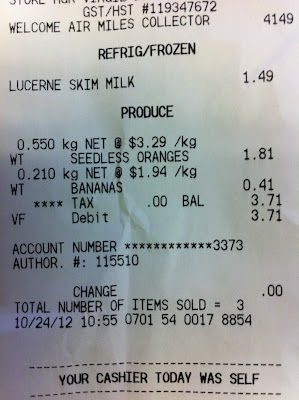


WTF? Something must be wrong with the receipt printer.. The damn thing shows NO TAX on the healthy food. This can't be. The Ontario Medical Association is having a hay-day in the media talking about their egalitarian concept to save Canada's overweight population by reducing tax on healthy food.
I didn't pay any tax on this healthy food. How does a tax get less than zero? I did pay tax on the junk food though, and the junk food was a buck more when compared to a similar number of servings of healthy food. yes you read that right.. the junk food cost more than the healthy food.
Do the doctors at OMA ever go shopping for food?
Did they actually check what foods are currently taxed and which are not before winding up their boisterous media blitz?
No? Whoops, minor oversight there.
As usual I do the heavy lifting and uncover the uncomfortable truth that nobody else does.
Actually I did a simple Google search; food tax Canada, and, looked at my grocery receipt.
This is not difficult to figure out, but, as usual, political hyperbole and media sensationalism distract people from the reality right in front of our faces. More entertaining to pay attention to the dancing bear than look at actual facts.
This link will show you all the foods that are and are not taxed in Ontario. All the provinces have near identical lists for provincial taxes, as does the country as a whole for GST and HST.
http://www.cra-arc.gc.ca/E/pub/gm/4-3/4-3-e.html
I really want Canadians to eat less and change their social norms so that healthy eating is embraced instead of scoffed at. I wouldn't mind seeing some of our tax dollars being put to good use with useful initiatives to help reduce and prevent the ever growing number of Canadians that are overeating their way to obesity and the ensuing health problems that hurt them.
I'm not going to hold my breath..
Back to reality..
Some research suggests that 10% tax on junk food can reduce purchases of junk food.
Of course, I have a serious problem with this research as most healthy food has long been cheaper, or at least competitively priced with junk food, yet most of our population choose junk food over healthy food much of the time.
Take a look at the receipts I've posted here. The 1 L of pop was $1.34 and the 1 L of skim milk 1.49. That's an insignificant difference. The pop was on sale so I payed $1.00 for it plus 12 cents tax. Still an insignificant difference.
What would the price look like with another 15% tax (30% total tax).. a doubling of the current tax?
Instead of paying $4.75 for a bag of chips and a pop I would have had to pay $5.49, 74 cents more.
I don't eat junk food (I gave away my junk food to an all too eager taker) so I don't care how much it costs. But for those who love their chips and pop I think most will find a way to pay an extra 10% or 15% over what they're paying now.
People overeat because they enjoy it, not because healthy choices are more expensive. "I'm going back for seconds on triple cheese pizza because broccoli is expensive." Nope, doesn't happen. You go back for seconds because it tastes so damn good you want more. That's the way that works. Good research shows that overeating fatty, sugary, salty food alters appetite regulation causing increased hunger and decreased satiety. The more you eat, the more your appetite regulation adapts to eating more.
And because of how our brain organizes memories of rewarding experiences, when we're hungry again we're likely to remember that we like pizza, so that is what we seek. These foods stimulate an above normal excitation of reward centres in the brain. That's why we perceive them as tasting extra good compared to a great tasting apple. Apple tastes great, but doesn't put reward perception into overdrive.
This is one of the strongest drivers of seeking out these foods. People are not strongly compelled to buy junk food because it's cheaper. People seek it out because of altered appetite and reward seeking regulation, a side effect of consuming these foods. Not to mention the fact that socially, junk food is more respected than healthy food.
This isn't about changes taxes, it's about changing behavior, and moving away from perceiving junk food as better than healthy food.
The whole add new tax to junk food thing is BS, top to bottom anyway, since it's already taxed.
So as far as the grocery store is concerned, which is where most Canadians will be spending most of their food budget, healthy food already has no tax and is cheaper than junk food which is taxed.
What about restaurants and delicatessens? Selfishly I would like to pay no tax on deli salads, where I and everyone else currently pays GST and PST on every menu item.
Because there is tax on healthy restaurant foods there exists the potential to mess with taxes here, but I'm still not completely sold on the idea that a fat tax or healthy = no-tax is going to be a reasonable primary strategy in the reversal of obesity in Canada.
The Ontario Medical Association seems to be aloof in placing at the top of their list of anti fat commandments a fat tax and reduced tax on healthy food for the obvious reasons I've already stated.
You know, why don't we just ignore the commandments from on high and start eating less. We'll feel much better dropping a few pounds.
I went to a grocery store, bought some junk food and some healthy food, and compared the receipts..


WTF? Something must be wrong with the receipt printer.. The damn thing shows NO TAX on the healthy food. This can't be. The Ontario Medical Association is having a hay-day in the media talking about their egalitarian concept to save Canada's overweight population by reducing tax on healthy food.
I didn't pay any tax on this healthy food. How does a tax get less than zero? I did pay tax on the junk food though, and the junk food was a buck more when compared to a similar number of servings of healthy food. yes you read that right.. the junk food cost more than the healthy food.
Do the doctors at OMA ever go shopping for food?
Did they actually check what foods are currently taxed and which are not before winding up their boisterous media blitz?
No? Whoops, minor oversight there.
As usual I do the heavy lifting and uncover the uncomfortable truth that nobody else does.
Actually I did a simple Google search; food tax Canada, and, looked at my grocery receipt.
This is not difficult to figure out, but, as usual, political hyperbole and media sensationalism distract people from the reality right in front of our faces. More entertaining to pay attention to the dancing bear than look at actual facts.
This link will show you all the foods that are and are not taxed in Ontario. All the provinces have near identical lists for provincial taxes, as does the country as a whole for GST and HST.
http://www.cra-arc.gc.ca/E/pub/gm/4-3/4-3-e.html
I really want Canadians to eat less and change their social norms so that healthy eating is embraced instead of scoffed at. I wouldn't mind seeing some of our tax dollars being put to good use with useful initiatives to help reduce and prevent the ever growing number of Canadians that are overeating their way to obesity and the ensuing health problems that hurt them.
I'm not going to hold my breath..
Back to reality..
Some research suggests that 10% tax on junk food can reduce purchases of junk food.
Of course, I have a serious problem with this research as most healthy food has long been cheaper, or at least competitively priced with junk food, yet most of our population choose junk food over healthy food much of the time.
Take a look at the receipts I've posted here. The 1 L of pop was $1.34 and the 1 L of skim milk 1.49. That's an insignificant difference. The pop was on sale so I payed $1.00 for it plus 12 cents tax. Still an insignificant difference.
What would the price look like with another 15% tax (30% total tax).. a doubling of the current tax?
Instead of paying $4.75 for a bag of chips and a pop I would have had to pay $5.49, 74 cents more.
I don't eat junk food (I gave away my junk food to an all too eager taker) so I don't care how much it costs. But for those who love their chips and pop I think most will find a way to pay an extra 10% or 15% over what they're paying now.
People overeat because they enjoy it, not because healthy choices are more expensive. "I'm going back for seconds on triple cheese pizza because broccoli is expensive." Nope, doesn't happen. You go back for seconds because it tastes so damn good you want more. That's the way that works. Good research shows that overeating fatty, sugary, salty food alters appetite regulation causing increased hunger and decreased satiety. The more you eat, the more your appetite regulation adapts to eating more.
And because of how our brain organizes memories of rewarding experiences, when we're hungry again we're likely to remember that we like pizza, so that is what we seek. These foods stimulate an above normal excitation of reward centres in the brain. That's why we perceive them as tasting extra good compared to a great tasting apple. Apple tastes great, but doesn't put reward perception into overdrive.
This is one of the strongest drivers of seeking out these foods. People are not strongly compelled to buy junk food because it's cheaper. People seek it out because of altered appetite and reward seeking regulation, a side effect of consuming these foods. Not to mention the fact that socially, junk food is more respected than healthy food.
This isn't about changes taxes, it's about changing behavior, and moving away from perceiving junk food as better than healthy food.
The whole add new tax to junk food thing is BS, top to bottom anyway, since it's already taxed.
So as far as the grocery store is concerned, which is where most Canadians will be spending most of their food budget, healthy food already has no tax and is cheaper than junk food which is taxed.
What about restaurants and delicatessens? Selfishly I would like to pay no tax on deli salads, where I and everyone else currently pays GST and PST on every menu item.
Because there is tax on healthy restaurant foods there exists the potential to mess with taxes here, but I'm still not completely sold on the idea that a fat tax or healthy = no-tax is going to be a reasonable primary strategy in the reversal of obesity in Canada.
The Ontario Medical Association seems to be aloof in placing at the top of their list of anti fat commandments a fat tax and reduced tax on healthy food for the obvious reasons I've already stated.
You know, why don't we just ignore the commandments from on high and start eating less. We'll feel much better dropping a few pounds.
Friday, March 2, 2012
Healthy Food Cheaper: Potato chips 1134% more $$ than potatoes
I originally wrote this after a radio interview with Karen Black of CJOB on this subject, back in 2012. Not much has changed since then. . .
Karen read off some price comparisons that I did a couple years ago showing how potato chips cost about 450% more than yams, when compared by cost per kilogram.
Karen made an interesting point.. we automatically assume that the potato chips are cheaper, and when we see the actual price comparison it seems unbelievable. The potato chips have to cost more than a raw potato because of all the processing involved. Think about it; up to the point of getting the potato out of the ground and ready to ship potatoes and potato chips cost about the same.
The potato chips have many extra processing steps, each adding cost. From washing, peeling, cooking, and adding salt and other ingredients, adding the packaging, and the cost of advertising, the final potato chip product would have to cost more than the simple unprocessed raw potato.
Potato chips are actually pretty expensive, around $4.00 to $6.00 per kilogram, or were, according to a cost check I did in 2010. Here's an add for potato chips in a recent flyer.. a great 3 for $8.00 sale..

Potato chips 810g for $8.00 is $9.87/ kg.
To be generous I'm assuming a person is buying the best deal; 3 of the 270g bags.
Looks like the price went up over the past 2 years. On my last grocery shop I bought a 5 lb bag of potatoes..

Potatoes 5 lb $1.97 (87 cents / kg)
Potato chips are $9.87/kg where potatoes are $0.87/ kg, a dimension bending 1134% more expensive for the potato chips.
It's been said that people have to buy potato chips because junk food is cheaper than healthy food.. I am actually infuriated by this bogus claim.
Here are more direct cost comparisons. See for yourself, most healthy choices are considerably cheaper than processed "junk food"..


Karen read off some price comparisons that I did a couple years ago showing how potato chips cost about 450% more than yams, when compared by cost per kilogram.
Karen made an interesting point.. we automatically assume that the potato chips are cheaper, and when we see the actual price comparison it seems unbelievable. The potato chips have to cost more than a raw potato because of all the processing involved. Think about it; up to the point of getting the potato out of the ground and ready to ship potatoes and potato chips cost about the same.
The potato chips have many extra processing steps, each adding cost. From washing, peeling, cooking, and adding salt and other ingredients, adding the packaging, and the cost of advertising, the final potato chip product would have to cost more than the simple unprocessed raw potato.
Potato chips are actually pretty expensive, around $4.00 to $6.00 per kilogram, or were, according to a cost check I did in 2010. Here's an add for potato chips in a recent flyer.. a great 3 for $8.00 sale..

Potato chips 810g for $8.00 is $9.87/ kg.
To be generous I'm assuming a person is buying the best deal; 3 of the 270g bags.
Looks like the price went up over the past 2 years. On my last grocery shop I bought a 5 lb bag of potatoes..

Potatoes 5 lb $1.97 (87 cents / kg)
Potato chips are $9.87/kg where potatoes are $0.87/ kg, a dimension bending 1134% more expensive for the potato chips.
It's been said that people have to buy potato chips because junk food is cheaper than healthy food.. I am actually infuriated by this bogus claim.
Here are more direct cost comparisons. See for yourself, most healthy choices are considerably cheaper than processed "junk food"..

Mini chocolate cupcakes $11.64/ kg

Pre-cut bagged broccoli $5.48/ kg. No excuses here, it's already cut..

Apple pie $6.33/ kg.
Hey wait a minute, this pie isn't cut. You know, I'm pretty busy.. I don't have the time to spend time cutting up pie..
Look inside your head.. If you're an apple pie lover, how do you feel when cutting into an apple pie, compared to chopping broccoli? I'll bet most will feel pretty motivated to cut the pie. Nobody will be contemplating how busy they are. When I've asked the average person why they don't feel as excited about cutting into a grapefruit or dicing veggies compared to pie or some other fat-bomb, most have looked at me like I have two heads.
It simply doesn't occur to us that great tasting healthy food deserves the feeling of anticipated gratification. We spend our lives practicing making the emotional connection to feeling rewarded by crap food and so this becomes our default. We don't contemplate this reward at all, we're trained to automatically compute the reward. At the same time we adopt traditional myths and negative associations with fruits and veggies as being second class citizens and instantly categorize them with our well-practice prejudice, automatically scoffing at the idea that one would actually look forward to or enjoy them to any great extent.

Grapefruit $0.97 each (444 grams) $2.18/ kg
Half this grapefruit is considered one serving.
The whole candy bar below is one serving. Costing out per serving, the candy bar is 19X more expensive. Whaaaat? That's 1900% more costly.
It is significantly cheaper to hand out grapefruit servings to kids (or anyone) than it is to hand out candy bars.
Ain't that like getting hit in the head with a frying pan? Wake-up call for sure.

Long ago I had an epiphany.. (I may have had another since then, epiphanies can be fickle). I was struck so profoundly by my personal insight I likened it to being hit in the head with a frying pan, so obvious, enlightening, and unavoidable a conclusion it was.
Not one of those lightweight cheap aluminium pans, but a full-on cast iron job that grandma used on the log-fired stove.
For a few years I had "frying pan day" in my calendar to remind me of the occasion and how sometimes we need to escape our myopic prejudices and get real. I seem to have forgotten what that epiphany was.. I'm sure it was a really important personal breakthrough.. but I did remember the frying pan crack in the head analogy for teaching us the wrongs of our ways.
Anyhoo, waking up to the reality that most of us fool ourselves every day when it comes to how and why we make our food and exercise (or lack of) choices qualifies for a "frying pan day" in my books.
A recent study suggests women who eat lot's of citrus fruits like grapefruit may reduce their risk of stroke by 19%. Any guess as to what happens to your body when you eat lot's of candy bars? How "convenient" is a stroke?
I love fresh, cool, juicy grapefruit. Keep it in the fridge for sure. I enjoy this more than I enjoy dark chocolate. No way you say? How does grapefruit compete with the intense chocolately goodness of premium dark chocolate? I really do enjoy the flavour, the juiciness is an extra, plus when I eat grapefruit I'm thinking of how nutritious it is. Nutrient density is a huge benefit and something worth feeling gratified for. This is an important step to teach ourselves when learning how to eat healthy.. making the health benefit association connection click in our heads and give us a sense of reward.
When I eat dark chocolate I know it tastes great, but at the same time I'm thinking that I have to temper how much I eat because the chocolate bar is a total calorie bomb that makes it really easy to import useless fat calories into my fat cells. Overall the chocolate bar isn't as rewarding as the healthy fruit because it falls short on delivering essential nutrients that our bodies need. Sure, dark chocolate does deliver a good dose of antioxidants, but no more than fruits and veggies, and not without the downside of extra calories negating any benefit of antioxidants with only a modest serving.

Candy bar $20.79/ kg
That's the same price as premium wild sockeye salmon.
At point of purchase this doesn't seem like it's expensive, but add up all the servings and compare by weight and by serving, this candy bar is the same price as wild salmon, a great source of healthy and essential omega 3 fats. One look at the price of salmon and most people balk. But what if you put a 52g piece of salmon next to this 52g piece of candy bar and put the same price on them?
Funny, we make excuses to buy candy bars because they are cheap, and avoid wild salmon because it's expensive. They are the same price.


Broccoli bunch $1.27 each (603g) $2.10/ kg
One of the most nutrient dense veggies you can get with plenty of research touting health benefits. Most people think broccoli is one of the most expensive veggies, and view junk food as considerably cheaper. The opposite is clearly true.
Broccoli is at least half the price as most junk food.

Premium dark chocolate bar $3.49 (100g) $34.90/ kg
Suspiciously, it appears someone has eaten half this item. Ok it was me.
I do this for you, my loyal reader. I'm testing this product on your behalf and can tell you it tastes really good, is VERY expensive, and has to be kept to a minimum otherwise the extra calories pack on the pounds relentlessly.


Organic pre-washed salad $17.50/ kg.
You may say, "ah ha! Gotcha Cris! this is really expensive."
Two points..
It's cheaper than a candy bar.
Plus, isn't your health worth something? The nutrient density of this salad is significantly higher than any of the junk food choices here.
If your excuse is convenience.. it takes too long to chop up veggies.. someone has done it for you here and you pay for that, plus a premium for the organic cache. Even with those extras's, the candy bar is still more expensive.
Make that 3 points. What do you think will happen to your waist line and risk of cardiovascular disease by eating this salad compared to adding junk food deserts and snacks?

Nanaimo bars $8.17/ kg.
Even on sale this easy to eat fat bomb is considerably more expensive than almost any fruit or vegetable.

Healthy energy bar $23.08/ kg.
You pay a premium price for energy bars with organic ingredients, especially those marketed at the health conscious outdoorsy sports person.
This is still cheaper than dark chocolate and about 11% more costly than a typical candy bar. Compared to a typical candy bar many energy bars are more nutrient dense and have less saturated fat, but read the label, some have just as much fat and sugar.

Cereal-fruit bar $10.10/ kg
While less than half the price of the premium energy bar as well as the common candy bar, this appears to be a better deal, and hey it says it's "made with real fruit". If you're looking for a fruit fix, you're better off buying fruit, which is significantly cheaper.
An orange, banana, or apple will cost about 35 to 45 cents and retain more nutrient density than a processed fruit bar, as well as having no added sugar or other ingredients. Surprisingly fruit is made with 100% real fruit, and nothing else.
Grapes. Expensive right? For sure. This is the fruit of Roman emperors.
Grapes are a premium fruit. Better to buy an inexpensive fruit bar instead right?

Red Seedless grapes $2.84/ kg -- about 72% less costly than the fruit bar.
These "costly" grapes are also cheaper than candy bars, with candy bars costing over 700% more.
Those cheap candy bars displayed at point of purchase for the quick impulse buy cost 700% more than red seedless grapes? Yes, it's an irrefutable fact.
That rattles the cage of most. "Can't be true!". I've seen the twisted facial expressions.. people simply can't believe it. Most are convinced there's some kind of catch, some kind of fancy tricky math meant to fudge the numbers. Nope.
It's a fact, most healthy food is significantly cheaper than fast food/ junk food. I used to believe the common urban myth that junk food is cheaper than healthy food. Indeed, how many times have we heard on the news that junk food is cheaper than healthy food making healthy food inaccessible to many? When I did a simple price comparison myself it was easy to bust the myth.
Part of the satisfaction of eating healthy is realizing that eating to feel stuffed is a misnomer that feels great to be liberated from. Instead of feeling ungratified from a salad not filling us up, we learn to realize, "hey wait a minute.. I had it all wrong, eating to the point of being stuffed was harming me, not helping me.. eating less is very satisfying because I know I'm not causing myself harm by overeating."
Once you get into the groove of not gaining weight, feeling great, and feeling satisfied by eating the right amount instead of always overeating, you feel liberated. You feel good. You're not trapped anymore.
One step to take is overcoming the myriad of well established myths about healthy living.
These myths are so well ingrained they are treated as emphatic facts and the truth of healthy living is treated as an impossible lie.
We are literally in the dark ages societally when it comes to understanding healthy living.
The flat-earthers are the standard and those making healthy choices are heretics and scatter-brains.. scolded publicly for spreading their sorcery and blaspheme about how healthy living is cheaper and more gratifying than unhealthy living.
The dark ages didn't help anyone. Let's lift ourselves out of this self imposed state of arrested development.
Overall healthy food is cheaper on the pocket book, and less costly in terms of health and well being.
Complaining about being out of energy and run down? Go on the cheap and start eating healthy. Within a couple weeks you'll feel the difference. You'll feel more energetic and lose weight.
Hmmm. Eating crap food makes you feel like crap and is so calorie dense we gain excess fat eating it, and it costs far more than healthy eating.
What's the point in eating all that junk food?
Subscribe to:
Posts (Atom)